


Max Beckmann, Composition (Gallwitz 286; Hofmaier 323-329; Rifkind 150 1-7), Der Mensch Ist Kein
Max Beckmann, Composition (Gallwitz 286; Hofmaier 323-329; Rifkind 150 1-7), Der Mensch Ist Kein
Estimated Price: $1075 - $1300
Couldn't load pickup availability
Condition: Pre-Owned
Lithograph on Van Gelder Zonen Btten paper.
Paper size: 8.6875 x 5.3125 inches.
Excellent condition.
Unsigned and unnumbered, as issued.
Notes: From the album, Der Mensch ist kein Haustier, 1937.
Published by ditions Cosmopolites, Paris; printed by Matre-Imprimeur, Desjobert, Paris, 1937.
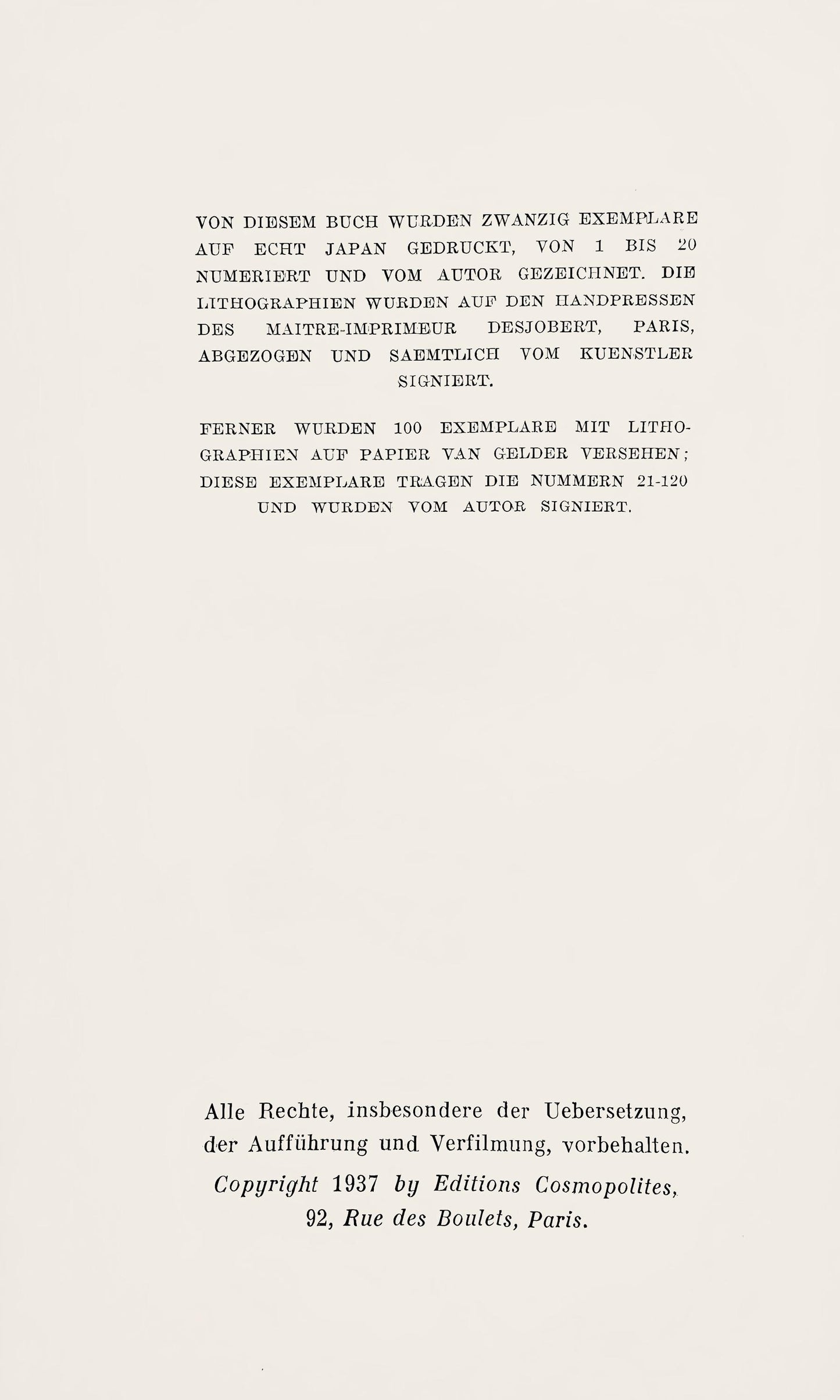
Excerpted from the album (translated from German), XX examples of this album were shot on Japon nacr, printed from I to XX, numbered and signed by the author.
The lithographies were drawn on the long arm presses of the Matre-Imprimeur, Atelier Desjobert, Paris, and signed by the artist.
In addition, C examples were shot with lithographs on papier Van Gelder; these examples bear the numerals XXI-CXX, and were signed by the author.
All rights, in particular of translation, performance and film adaptation, reserved.
Copyright 1937 by ditions Cosmopolites, 92, Rue des Boulets, Paris.
Excerpted from the catalogue entry for the example from this edition owned by the Museum of Modern Art, In Stephan Lackner's play Der Mensch ist kein Haustier (Man is not a domestic animal), a violent revolution has unleashed uncontrollable forces in an unnamed land.
Felix Faber, logical and heartless, heads the overthrow; his henchman, Peter Giel, betrays him out of love for Duchess Louise.
The story follows these three main characters, whose lives remain intertwined as they make their way through the new world.
In 1936 Lackner, then living in exile in Paris, commissioned Beckmann to illustrate his play.
At the time, the playwright described himself as "Beckmann's student in a different medium," and stated that Beckmann's art and vision of the world as a theater were the inspiration for the play's main characters.
Beckmann, upon reading the finished draft, marveled at the similarities of their ideas.
The artist completed the seven lithographs, his first since 1923, shortly after fleeing Nazi Germany in summer 1937.
He visited Lackner in Paris, where he signed the printsan activity that he said reminded him "of better days"in September.
The book was published later that fall. Beckmann's illustrations, in which he gave Giel his own features, focus on the human responses to the upheaval, showing emotional scenes of love, intoxication, and destruction.
All items are carefully packed and shipped via insured courier services. Processing time: 1–3 business days.
Tracking details will be provided once shipped.
Read more of our
Shipping Policy.
All sales are final unless otherwise stated. Authenticity guaranteed. Please read full terms on our website before purchase.
Read more of our
Terms of Service.


Upcoming Auctions
View AuctionsThe Collector's Corner
12/08/2025 at 09:00 AM EST


The Luxe Edit: First Look
12/08/2025 at 09:00 AM EST


The Luxe Edit: Evening Edition
12/08/2025 at 07:00 PM EST


The Collector's Corner
12/09/2025 at 09:00 AM EST


The Luxe Edit: First Look
12/09/2025 at 09:00 AM EST


The Luxe Edit: Evening Edition
12/09/2025 at 07:00 PM EST

