


Paul Gauguin, Women At The River (Auti Te Pape), Woodcut
Paul Gauguin, Women At The River (Auti Te Pape), Woodcut
Estimated Price: $775 - $950
Couldn't load pickup availability
Condition: Pre-Owned
Woodcut on vlin Utopian paper.
Paper Size: 13 x 17 inches.
Excellent condition.
Inscription: Unsigned and unnumbered, as issued.
From the folio, Gauguin, A portfolio of 12 color woodblocks, Paul Gauguin, French, 1848-1903 from the collection of The Museum of Fine Arts, Boston, 1946.
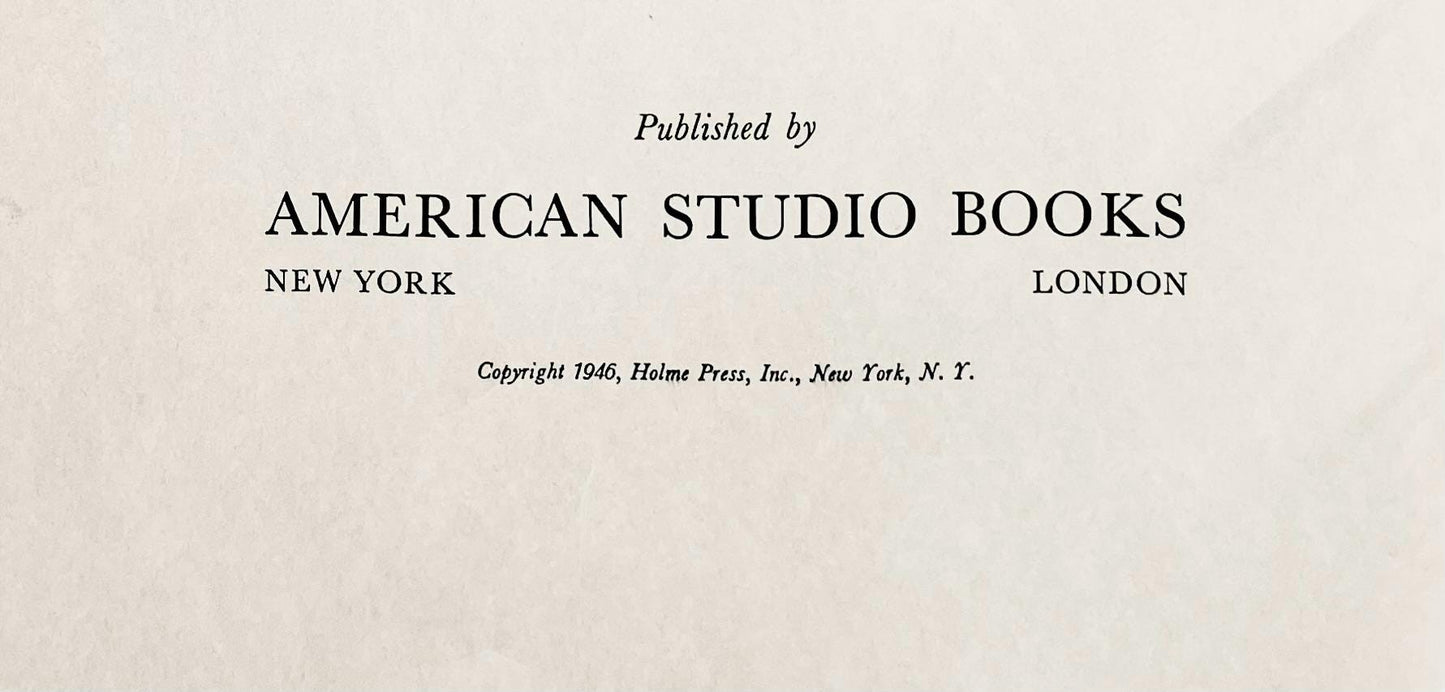
Rendered by Albert Carman (1899-1949); published by The Museum of Fine Arts, Boston and The Studio Publications, Inc., New York and London; printed by Holme Press Inc., New York, in an edition of MMMD.
Excerpted from the folio, Paul Gauguin and Emil Bernard at Pont-Aven, Brittany, in 1888, each made a bas-relief, wooden panel to decorate a piece of furniture for a friend.
In order to keep a record of their designs, a few inked impressions were made on paper.
The illustration at left is a reproduction of a print which is possibly one of the above mentioned.
It is further possible that this experiment later gave Gauguin the idea of making woodcuts.
Just as his work in painting expressed a revolt against the overemphasis on factual representation of the nineteenth century in favor of decorative pattern and color, so also his woodcuts leaned strongly to the same side of the balance.
Ten of the cuts reproduced (all excepting Soyez Amoureuses and Changement de Residence), which constitute the whole of his best known series, were made at Pont-Aven beginning in the fall of 1894, after Gauguin's return from his first trip to Tahiti and after he broke his ankle.
They were at first roughly cut with a common carpenter's gouge, and the flat surfaces sandpapered and engraved with a sharp in-strument, perhaps an engraver's burin.
A few trial proofs were printed in black ink only.
Then the hollows were deepened with a woodcutter's gouge and highlights were added.
An edition of thirty to fifty impressions of each subject, with the addition of color blocks (one, two or three), was made by Louis Roy, a painter friend of Gauguin's.
The use of the added blocks was doubtless sanctioned by Gauguin, but by which man they were made, by him or by Roy, is questionable in my mind and in that of Mr.
Henry P.
Rossiter, Curator of Prints at the Boston Museum of Fine Arts.
The fact that in all the later two-color woodcuts made by Gauguin during his second and final visit to Tahiti (2895-1903) both blocks have engraving on the flat surfaces would in some measure substantiate the doubt, hitherto unmentioned by any commentator.
The two very beautiful remaining reproductions in the portfolio are examples of the later work, which illustrate my point.
W.
G.
Russell Allen. Rendered by Albert Carman; published by American Studio Books, New York and London.
All items are carefully packed and shipped via insured courier services. Processing time: 1–3 business days.
Tracking details will be provided once shipped.
Read more of our
Shipping Policy.
All sales are final unless otherwise stated. Authenticity guaranteed. Please read full terms on our website before purchase.
Read more of our
Terms of Service.


Upcoming Auctions
View AuctionsThe Collector's Corner
12/08/2025 at 09:00 AM EST


The Luxe Edit: First Look
12/08/2025 at 09:00 AM EST


The Luxe Edit: Evening Edition
12/08/2025 at 07:00 PM EST


The Collector's Corner
12/09/2025 at 09:00 AM EST


The Luxe Edit: First Look
12/09/2025 at 09:00 AM EST


The Luxe Edit: Evening Edition
12/09/2025 at 07:00 PM EST

