


Rembrandt Van Rijn, Jacob'S Dream, Drawings From The Bible, Collotype
Rembrandt Van Rijn, Jacob'S Dream, Drawings From The Bible, Collotype
Estimated Price: $775 - $950
Couldn't load pickup availability
Condition: Pre-Owned
Collotype on Hamilton Kilmory paper.
Unsigned and unnumbered, as issued.
Paper Size: 12.5 x 9.5 inches.
Excellent condition.
Notes: From the folio, Rembrandt, Drawings from the Bible, Thirty-two Collotype Facsimiles, 1947.
Published and printed by Schocken Books, Inc., New York, in an edition of MM.
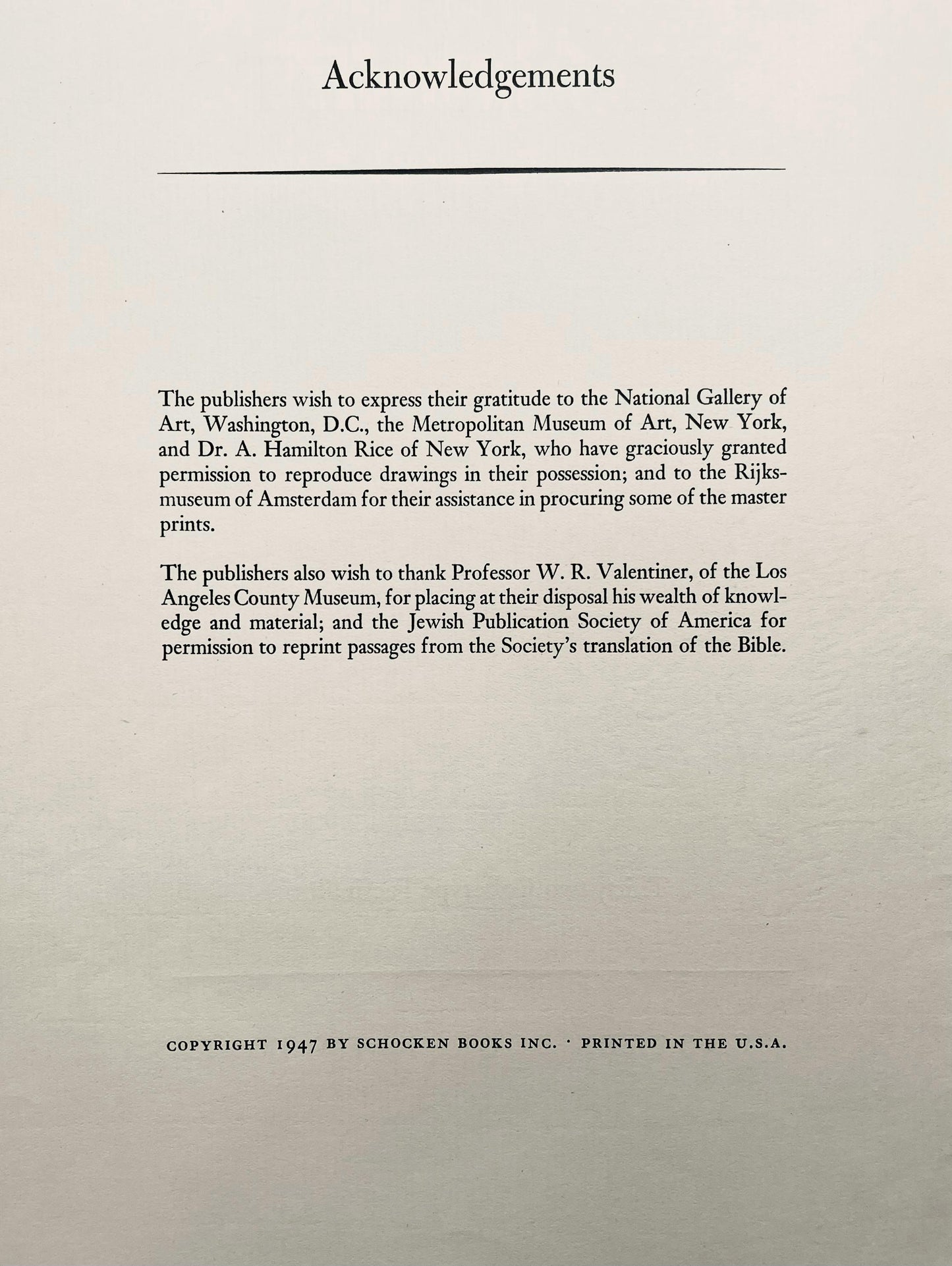
Excerpted from the folio, The publishers wish to express their gratitude to the National Gallery of Art, Washington, D.C., the Metropolitan Museum of Art, New York, and Dr.
A.
Hamilton Rice of New York, who have graciously granted permission to reproduce drawings in their possession; and to the Rijks-museum of Amsterdam for their assistance in procuring some of the master prints.
The publishers also wish to thank Professor W.
R.
Valentiner, of the Los Angeles County Museum, for placing at their disposal his wealth of knowledge and material; and the Jewish Publication Society of America for permission to reprint passages from the Society's translation of the Bible.
The thirty-two drawings in this collection were made over a period of thirty years, a period covering most of Rembrandt early painting.
The intense preoccupation with biblical themes to which they bear witness was doubtless inherited from the devout Protestant home in which he was born and raised.
During the years of his youth there lived in his native Leyden those Pilgrims who were to make the Bible the law of a new home in Amer-ica.
One senses, in Rembrandt's early painting of his mother absorbed in reading the Bible, the power the biblical tradition exercised in his home.
It is natural then that among his earliest known works there should be scenes from the Bible.
Much less natural, however, is the fact that he returned again and again to these subjects throughout his life, that when he died at the age of sixty-three a large painting of Mordecai, Esther, and Ahasuerus stood in his studio.
For Protestant devotion to Scripture was austerely moral rather than sensual; it valued ethics, not esthetics.
The plain, bare Meeting House of Protestant society offered painters neither the spiritual satisfaction nor the remuneration of a patronized religious art.
Notoriety and substance were only to be had by portraying its wealthy burghers.
And yet of some six hundred known paintings by Rembrandt about a hundred and fifty depict scenes from the Bible.
The piety of his home bent the twig but gave the branch no nourishment.
A sensual, visual image was needed for an art that used biblical themes not as icons and religious symbols but as tales of human pathos.
This image Rembrandt found in the Spanish Jews newly arrived in Amsterdam.
A colorful and alien element among the sober Dutch, strange in apparel, strange in the very cast of their faces, they attracted the young man who had never left his little country.
In an age of Baroque, with Italy still considered the mother of the arts, the Amsterdam ghetto may at first have been simply a refuge from the unexciting sobriety of Dutch life.
Possibly he saw in these exotic immigrants merely models for Oriental scenes; perhaps only later did he identify them with their biblical ancestors. In the end, however, his interest becomes so deep and so intimate-his own misfortunes blending with theirs-that the Bible tale is simply the vehicle for a study in human emotion.
All items are carefully packed and shipped via insured courier services. Processing time: 1–3 business days.
Tracking details will be provided once shipped.
Read more of our
Shipping Policy.
All sales are final unless otherwise stated. Authenticity guaranteed. Please read full terms on our website before purchase.
Read more of our
Terms of Service.


Preview upcoming auctions and place a bid early.
The Luxe Edit: Evening Edition
12/10/2025 at 07:00 PM EST


The Collector's Corner
12/11/2025 at 09:00 AM EST


The Luxe Edit: First Look
12/11/2025 at 09:00 AM EST


The Luxe Edit: Evening Edition
12/11/2025 at 07:00 PM EST


The Collector's Corner
12/12/2025 at 09:00 AM EST


The Luxe Edit: First Look
12/12/2025 at 09:00 AM EST


The Luxe Edit: Evening Edition
12/12/2025 at 07:00 PM EST


The Collector's Corner
12/13/2025 at 09:00 AM EST


The Luxe Edit: First Look
12/13/2025 at 09:00 AM EST


The Luxe Edit: Evening Edition
12/13/2025 at 07:00 PM EST

